
Facials
What is a facial cleansing treatment and what is it for
If you have ever felt that your skin looks dull, with visible pores or small impurities that your everyday face wash simply cannot fix, you have probably already needed a professional facial cleansing. This is not a luxury or a treatment reserved for special occasions — it is the basic maintenance your skin needs on a regular basis, much like your teeth need a professional cleaning beyond daily brushing.
A professional facial cleansing is one of the most requested treatments at any skin care center, and also one of the most misunderstood. Many people arrive thinking it is just a wash with fancy products, or that it is very painful, or that it is unnecessary if they already follow a skincare routine at home. This article will clear up those doubts calmly: what it actually is, what happens during the procedure, which skin types it is suited for, and what to expect before and after.
The goal is not to talk you into anything. It is to leave you with clear information so you can make an informed decision about your facial care.
What happens inside a pore and why at-home cleansing is not always enough
Your skin produces sebum continuously. That oil serves a protective function: it keeps the skin barrier hydrated and shielded from external agents. The problem arises when sebum mixes with dead skin cells, dust, makeup residue, and environmental pollution. That mixture builds up inside the follicle and forms what we know as comedones — either open (blackheads) or closed (whiteheads).
Living in a city like Bogotá, with the pollution load that comes with heavy traffic in high-circulation areas, means this buildup happens more quickly. The facial cleansers available on the market do an excellent job at the surface, but they cannot soften and extract what is already lodged deep inside the pore. That requires specific steps that can only be carried out properly with the right equipment and technique.
Over time, the buildup can also alter skin texture, make pores look larger, and prevent the products you use at home from penetrating properly. Skin with clogged pores absorbs far less of the active ingredients in a serum or moisturizer, no matter how good the formula is.
The steps of the procedure, one by one
A professional facial cleansing follows an ordered protocol. The steps may vary slightly depending on the center or skin type, but the general sequence is consistent.
Makeup removal and initial cleansing. The treatment begins by removing any traces of makeup, sunscreen, or surface dirt. Products suited to the client’s skin type are used, and this step is more thorough than it might seem: the esthetician works with specific movements to ensure no residue is left that could interfere with the steps that follow.
Skin analysis. With the skin clean and under good lighting, the esthetician evaluates the skin type, the areas with the greatest buildup of impurities, the presence of comedones, redness, or any particularity that should be taken into account when adapting the protocol. This moment matters: if you have any active condition such as inflammatory breakouts, the approach will be adjusted accordingly.
Steam or vaporization. Steam is applied to the face for several minutes. The moist heat dilates the pores and softens the contents of the comedones, which makes subsequent extraction easier and reduces discomfort. Some equipment uses ozone steam, which has additional cleansing properties.
Exfoliation. An exfoliant is applied to remove the dead cells accumulated on the surface. This may be a physical exfoliation (with gentle particles), a chemical one (with low-concentration acids), or an enzymatic one, depending on what best suits the skin.
Comedone extraction. This is the step that raises the most questions. The esthetician manually extracts comedones using technique and, when necessary, sterile instruments. Work is done only on comedones that are already ready to come out: forcing what is not yet ready irritates the skin and can leave marks. A proper extraction, done with the right technique, does not leave bruising.
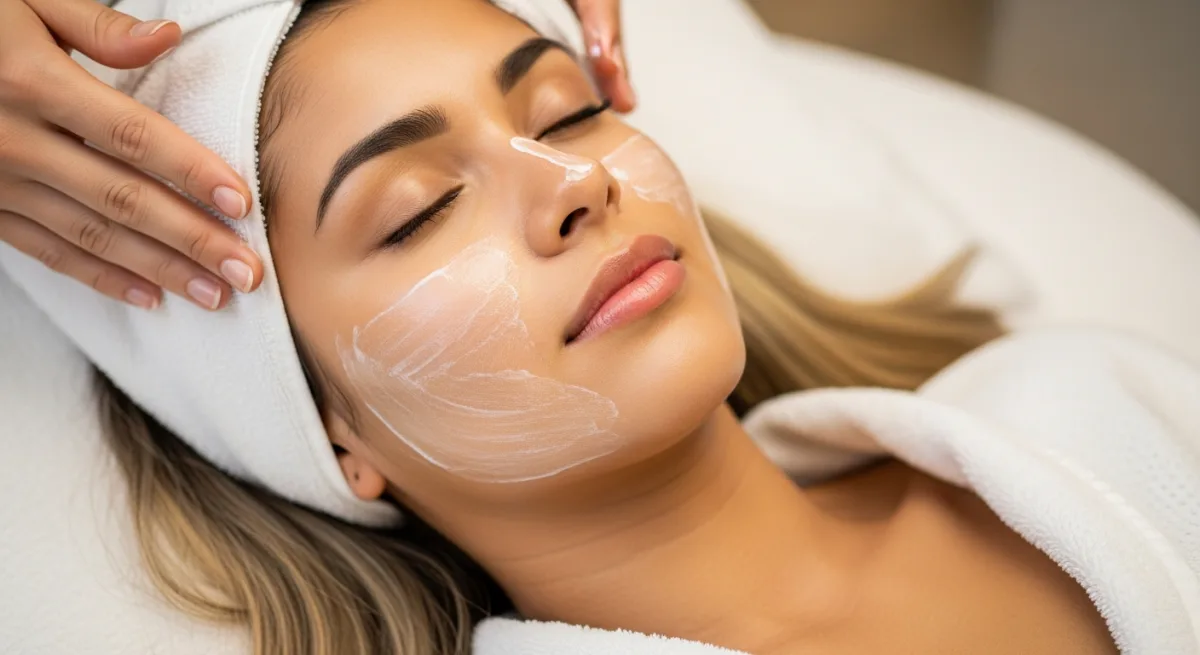
Mask and active ingredients. After extraction, the skin needs to calm down and receive nourishment. A mask is applied according to the goal (soothing, purifying, hydrating), followed by actives such as serums or ampoules. The skin is especially receptive at this point because the pores are clean and open.
Pore closing and protection. The protocol ends with products that help close the pores and protect the skin barrier. If the treatment takes place during the day, sunscreen is applied as the final step.
Which skin types it is suited for
One of the most common misconceptions is that a facial cleansing is only for oily or acne-prone skin. That is not the case. Every skin type benefits from this treatment, though the protocol is adapted in each situation.
Oily and combination skin. This is where results are most immediately visible, because there tend to be more comedones and more visibly enlarged pores. The treatment reduces that feeling of “congested skin” and noticeably improves texture.
Dry skin. The buildup of dead cells is especially common in dry skin, and it prevents hydrating products from penetrating properly. The facial cleansing removes that layer and allows moisture to reach where it needs to go.
Sensitive skin. Gentler, fragrance-free products are used, and extractions are limited or adapted based on the skin’s tolerance. Steam may be shortened or applied at lower intensity. Sensitive skin is not excluded from the treatment — it simply requires more care in product selection and technique.
Mature skin. As we age, cell turnover slows down and the skin can accumulate dead cells more easily. A facial cleansing, combined with actives formulated for mature skin, helps maintain a more even texture.
What to expect right after and how to care for your skin in the hours that follow
When the treatment is finished, it is completely normal for your skin to be slightly pink. That is not a sign that something went wrong — it is the natural response of circulation to the steam, massage, and extraction. In most cases that redness fades within a few hours.
In the areas where extractions were performed, there may be some sensitivity or small temporary marks. That is also normal and resolves on its own within a day or two. What is not normal is large bruising or persistent pain: if that happens, let your esthetician know.
Aftercare in the following hours is simple but important. Avoid makeup for at least 24 hours. Your pores are clean and open, and covering them immediately with foundation or powder can clog them again before they have time to close. Wear sunscreen if you go outside, because your skin is more sensitive to UV radiation right after exfoliation. Avoid intense exercise and excessive sweating that same day, and try not to touch your face more than necessary.
In the days that follow, your skin may seem to break out a little, especially if you had deep impurities that the treatment brought to the surface. That does not mean the treatment harmed you — it is part of the purification process. If the breakouts are intense or do not clear up within a week, consult your esthetician or a dermatologist.
The difference between doing the treatment once and keeping it up over time
A single facial cleansing visibly improves the skin, but the real benefit comes from consistency. Your skin produces sebum every day, cells renew continuously, and exposure to pollutants does not stop. That means buildup returns, and periodic maintenance is what sustains the results.
The ideal frequency varies depending on skin type and lifestyle. For most people, once a month works well. For very oily skin or a strong tendency toward comedones, shortening that interval may be worthwhile. For dry or sensitive skin, spacing it out a little more can be sufficient. Your esthetician is best placed to guide you on this after evaluating your skin in person.
Keeping up the treatment over time also has another effect that becomes noticeable gradually: your skin responds better to your at-home routine. The actives in your products penetrate more efficiently, hydration holds better, and overall texture improves progressively. It is not a dramatic overnight change, but a sustained improvement built with each session.
At Aqua Belleza Spa, facial treatments are approached with that continuity in mind: it is not about a single visit, but about accompanying each person in caring for their skin over time. If you would like to see what options are available, current pricing and full services are on our Services page.
Questions worth asking your esthetician before you start
Before your first facial cleansing — or even if you have had several — there is information worth sharing with the person who will be treating you. It is not an interrogation: it is the foundation for making the treatment as well-suited to your skin as possible.
Let them know if you are using retinol or other acids in your nighttime routine. Those actives increase skin sensitivity and may require adjustments to the exfoliation step. If you are taking any medication that affects the skin, such as isotretinoin, it is important to mention it because some treatments are not compatible with certain medications. Also mention any known allergies to cosmetic ingredients.
If you have doubts about whether a specific treatment is appropriate for your skin condition, consulting a dermatologist before proceeding is always a valid option. The esthetician works in the realm of care and aesthetics; the doctor is the one who diagnoses and treats clinical conditions. Both roles are complementary, not mutually exclusive.
For those in northern Bogotá, Aqua Belleza Spa is located at Cra 11 #98-14, just steps from Calle 98, making it easily accessible from various points in the area. If you would like to book an appointment or have questions about the treatment before coming in, you can do so directly from the Reservations page or reach us through the Contact page.
Skin care does not have to be complicated. A well-executed facial cleansing, at the right frequency for your skin type, is one of the most solid foundations on which to build any facial care routine.
Related references
Frequently Asked Questions
- How often should I get a facial cleansing treatment?
- For most people, once a month is the right frequency. If you have oily skin or a tendency toward acne, your esthetician may recommend every three weeks. If your skin is dry or sensitive, every six to eight weeks is usually enough.
- Does a facial cleansing treatment hurt?
- Extracting blackheads and whiteheads can cause some momentary discomfort, but it should not be painful. An experienced esthetician uses a gentle technique and only extracts what the skin is already ready to release. If you feel intense discomfort, let them know right away.
- Can I wear makeup the same day as my facial cleansing?
- Ideally, wait at least 24 hours before applying makeup. Your pores are open and clean right after the treatment, and covering them immediately can clog them again. If you absolutely need to wear makeup that day, use non-comedogenic, lightweight-formula products.
- Does a facial cleansing treatment help with acne?
- The treatment helps clear clogged pores that can contribute to the formation of comedones. However, acne is a condition that may require medical or dermatological attention. Your esthetician can complement your care routine, but cannot replace a medical specialist when acne is moderate or severe.
- What is the difference between a facial cleansing and a deep cleansing?
- The terms are used interchangeably at many spas, but in general a deep cleansing includes all the steps of a standard facial cleansing plus additional hydration protocols or targeted treatments based on your skin type. The best approach is to ask your esthetician directly what each service includes.
- Can I get a facial cleansing if I have very sensitive skin?
- Yes, but the protocol is adapted. Prolonged ozone steam is avoided, gentler products are used, and extractions are limited or skipped depending on how your skin reacts. Always tell your esthetician about your skin type before the session begins.