
Facials
How often should you get a deep facial cleanse (and how to tell when it's time)
There is a question we hear all the time at the spa: “How often should I get a deep facial cleanse?” And the honest answer is: it depends. Not on a universal rule, but on your specific skin, how you live, where you live, and what your skin is going through right now.
What is true is that most people wait too long between sessions — or, on the other end of the spectrum, book them so frequently that the skin never has enough time to recover properly. Neither extreme does your complexion any favors. This article is here to help you understand the logic behind frequency, so you can make informed decisions about your facial care routine.
You will not find a magic formula here that works for everyone. What you will find is a clear framework for reading your own skin’s signals and knowing when it is time to get back on the treatment bed.
Why your skin’s cycle matters more than the calendar
Skin has its own rhythm. Epidermal cells renew themselves in a cycle of around 28 days in younger people, a cycle that lengthens with age. That renewal process means dead cells accumulate on the surface, sebum mixes with them, and pores gradually become congested. A deep cleanse intervenes at exactly that point: it unclogs, exfoliates, and primes the skin to absorb whatever comes next.
Doing it before that cycle is complete can be counterproductive. If the skin is still in the middle of regenerating, subjecting it to aggressive extraction can irritate new tissue and break down the natural protective barrier. That is why frequency is not arbitrary or a commercial recommendation — it is grounded in basic biology.
That said, the 28-day cycle is an average. Factors like age, genetics, stress, pollution, and diet can speed it up or slow it down. Living in a city like Bogotá, with its altitude and the pollution levels typical of a capital city, means that particle buildup in the pores is greater than in rural or coastal environments. That does not mean you should get a cleanse every week, but it does mean your skin works a little harder than that of someone living in a less exposed setting.
Frequency by skin type
This is the most important variable. Before thinking about dates, you need to be clear on your skin type, because the right frequency varies considerably from one type to another.
Oily or combination skin: this is the type that benefits most from frequent cleansing. High sebum production means pores clog quickly. In this case, a deep cleanse every three to four weeks is usually appropriate. If pores are very large and the tendency toward comedones is high, your esthetician can adjust that interval.
Normal skin: there are no extreme urgencies in either direction. A deep cleanse every four to six weeks keeps things balanced without overstimulating the skin. This skin type responds well to treatments and recovers quickly.
Dry or dehydrated skin: this type requires the most care when it comes to frequency. Exfoliation and extraction can disrupt the hydrolipidic barrier, which is already more fragile in dry skin. Spacing sessions out to every six to eight weeks, and making sure the protocol includes an intensive hydration phase at the end, is the most sensible approach.
Sensitive or reactive skin: here, observation is key. Some sensitive skin types tolerate a gentle cleanse well every month; others need more time between sessions. If your skin reacts with prolonged redness or flaking after a treatment, that is a signal to extend the interval or adjust the protocol.
The signals that tell you it is time
Beyond the calendar, your skin speaks to you. Learning to read it is more useful than following a rigid schedule. There are some fairly clear signals that a deep cleanse is overdue.
The first is dullness. When skin loses its glow and looks flat even after being well moisturized, it is usually because a layer of dead cells and residue is blocking the skin’s natural radiance. A deep cleanse removes that layer and restores the luminosity that is characteristic of clean skin.
The second signal is visibly congested pores. If you look closely in the mirror and notice blackheads, whiteheads, or pores that appear enlarged and full, it is time to act. The longer those blockages go unaddressed, the harder they are to remove without irritating the surrounding tissue.
The third is uneven texture. Skin that feels rough to the touch, has small bumps beneath the surface, or does not absorb moisturizer well is asking for a deep exfoliation followed by a thorough cleanse. The hydration you apply at home cannot penetrate properly if there is a barrier of dead cells blocking the way.
What happens during a deep facial cleanse
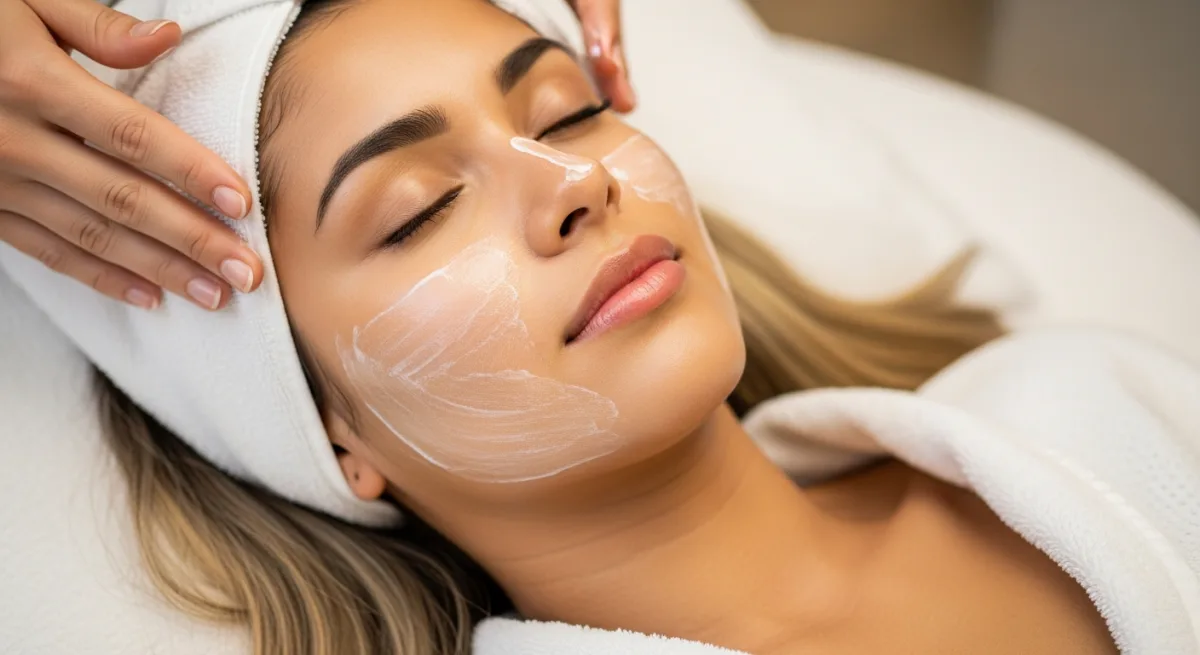
Understanding the procedure helps you prepare and know what to expect afterward. A deep cleanse is not the same as washing your face at home, even if it starts in a similar way.
The process generally begins with a surface cleanse to remove makeup, sunscreen, and excess sebum. Then comes a steam or gentle heat phase to soften the pores and make extraction easier. That is the step that makes all the difference: with open pores, the extraction work is more effective and less traumatic for the skin.
Comedone extraction is the most technical step. An experienced esthetician knows how much pressure to apply, in which direction, and when to stop. Forcing an extraction without proper preparation can break capillaries, leave marks, or introduce bacteria. After extraction comes the calming phase: an astringent toner to close the pores, a mask tailored to the skin’s needs, and always a hydration and protection phase at the end.
Total time varies depending on the protocol and the condition of the skin. At Aqua Belleza Spa, the treatment is adapted to what each skin needs in that moment, not to a fixed script. If you want to know exactly what each option includes, the details are on the Services page.
How to care for your skin after the cleanse
Aftercare is just as important as the treatment itself. A deep cleanse leaves the skin in a receptive state: pores are more open, the tissue has been stimulated, and the protective barrier is temporarily more permeable. What you do in the following 24 to 48 hours can either amplify or undo the results.
The first concern is sun exposure. After a deep cleanse, skin is more susceptible to UV radiation. Avoid direct sun for the rest of the day and apply broad-spectrum sunscreen the following day, even if it is overcast. In Bogotá, UV radiation can be high even under a cloudy sky due to the altitude, so this is not optional.
The second is makeup. Wait at least a day before applying it again. Freshly cleansed pores are far more prone to clogging if you cover them immediately with foundations or powders. If you need to go out that day, a lightweight sunscreen is enough.
The third is at-home exfoliation. Do not exfoliate for at least a week after the cleanse. The exfoliation work was already done in the treatment room; repeating it at home too soon can irritate the skin and undo the benefits. Focus on gentle cleansing, thorough moisturizing, and protection.
How to build a routine that sustains the results
A deep cleanse is a targeted intervention, not a permanent fix. The results last longer and are amplified when they are part of a consistent routine, both at home and at the spa.
At home, the pillars are simple: gentle cleansing morning and night, moisturizer suited to your skin type, and sunscreen every single day. That is non-negotiable. Without that foundation, the benefits of the deep cleanse fade quickly, because impurity buildup returns faster.
At the spa, the deep cleanse can be complemented with other treatments depending on what your skin needs. If there is marked dehydration, a deep hydrating facial after the cleanse can be very effective. If there are dark spots or a lack of radiance, BB Glow may be worth considering in a subsequent session. The order and combination of treatments is best defined by a professional who knows your skin well.
The area in northern Bogotá around Calle 98 and Cra 11 has a solid range of wellness services, but consistency with the same team makes a real difference. When your esthetician knows your skin’s history, she can fine-tune protocols with far greater precision than if you switch locations every session.
If you want to start or restart a facial cleansing routine, the first step is to book an appointment for a skin assessment so you can work out together the most appropriate frequency for you. You can do that directly from the Reservations page or reach us through the Contact page if you have questions before your first visit.
Related references
Frequently Asked Questions
- Does a deep facial cleanse hurt?
- There may be some discomfort during comedone extraction, especially if the pores are heavily congested. However, an experienced esthetician regulates the pressure and works on hydrated tissue to minimize discomfort. The sensation is tolerable for most people.
- Can I wear makeup after a deep facial cleanse?
- Ideally, wait at least 24 hours before applying makeup. The skin is left with open pores and is more receptive, and covering it immediately can cause blockages. If you need to go out that same day, use only a lightweight sunscreen.
- Is a deep facial cleanse good for acne?
- A deep cleanse helps unclog pores and reduce the sebum buildup that triggers breakouts. It is not a medical treatment for acne, but as part of a consistent skincare routine it can help keep skin cleaner and more balanced. If you have severe active acne, consult a dermatologist first.
- How often should I get a cleanse if I have dry skin?
- With dry skin, once every two months is usually enough. More frequent sessions can disrupt the hydrolipidic barrier and increase the feeling of tightness. Between sessions, focus on a consistent at-home moisturizing routine.
- What is the difference between a facial cleanse and a hydrating facial?
- A deep cleanse focuses on unclogging pores, exfoliating, and extracting impurities. A hydrating facial prioritizes replenishing the moisture barrier and calming the skin. Many protocols combine both steps: cleansing first, then hydrating. You can explore the available options on the Services page.
- Is it normal for skin to look red after the treatment?
- Yes, it is completely normal. Mild redness is a circulatory response to the manual work on the skin and usually fades within a few hours. If it persists for more than 48 hours or noticeable swelling appears, it is advisable to contact your esthetician.