
Lashes & Brows
Eyelash extensions: what to expect before, during, and after the service
Lashes have a quiet way of changing an entire expression. It does not take much: a little more length, some added curl, a touch of density — and suddenly the eyes look more rested, more defined, more like you. That is why eyelash extensions have become one of the most in-demand services at beauty spaces, not as an occasional luxury but as a regular part of many people’s self-care routines.
It is also a service that raises legitimate questions. How long do they last? Do they damage natural lashes? Which technique suits my eyes? What should I avoid after the appointment? This post answers those questions honestly, without overpromising results that depend not only on the service itself but also on your habits and your biology.
Whether you are considering eyelash extensions for the first time or you already know them and simply want to understand how to care for them better, here is a complete guide to help you make an informed decision.
What eyelash extensions actually are and how they work
Eyelash extensions are synthetic, silk, or faux-mink fibers that are bonded one by one onto each natural lash using a cosmetic-grade cyanoacrylate adhesive. The key detail is this: the extension is not placed on the skin or the eyelid — it is placed on the existing lash hair itself, at a safe distance from the root.
This method means extensions follow the life cycle of your natural lashes. Like all hair, lashes go through a cycle of growth, rest, and shedding. When a natural lash falls out, the extension attached to it falls with it. That is why the result is not permanent and requires regular maintenance: fills replace the extensions that have shed along with the natural lashes.
The quality of the result depends on several factors: the technician’s skill, the quality of the adhesive, the type of fiber chosen, and — to a significant degree — the condition of your natural lashes at the time of application. Healthy, clean lashes free of makeup residue or oils are the best foundation for the adhesive to bond well and for the extensions to last as long as they should.
Technique types: which one suits your eyes best
There is no single way to apply eyelash extensions. Techniques differ mainly in the number of extensions placed per natural lash and the thickness of the fibers used.
Classic volume is the starting point. One extension is placed on each natural lash, giving a defined look without being over the top. The effect is closest to a well-applied coat of mascara: more length, more curl, but no added density. It is the ideal choice if you want an everyday, understated result, or if it is your first time and you want to see how your lashes respond.
Russian volume works differently. Instead of one extension per lash, the technician builds small fans of two to six very fine fibers, all bonded to a single natural lash. The result is far denser and more dramatic, yet not necessarily heavier, because the individual fibers are thinner than those used in classic. This technique requires more application time and greater precision from the technician.
Between these two options sits hybrid volume, which combines classic extensions in some areas with Russian volume fans in others, creating a more varied texture that many people find especially natural-looking. The right choice depends on the shape of your eyes, the density of your natural lashes, and the effect you are going for. An experienced technician can guide you before the session begins.
What the application session is like and what you will feel
An eyelash extension session is, in many ways, one of the most relaxing appointments you can have at a beauty space. You lie back with your eyes closed for the entire application. There is no pain. Many people fall asleep.
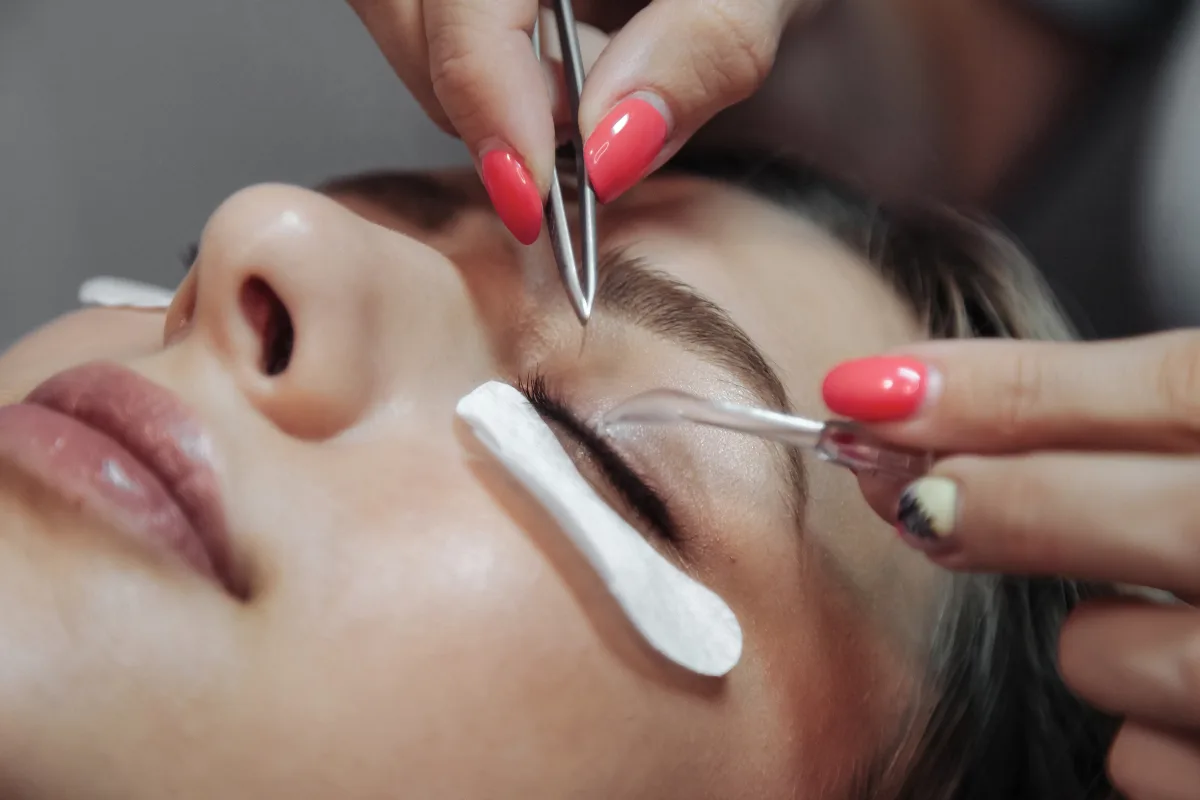
Before starting, the technician cleanses the lashes to remove any trace of makeup, sebum, or moisture. Small under-eye pads or tape are then placed on the lower lid to separate the bottom lashes and protect the skin. From there, the technician works lash by lash with precision tweezers, picking up each extension, applying a minimal amount of adhesive, and placing it on the natural lash.
A full application takes approximately two hours, depending on the technique chosen and the number of lashes you have. Fills, which only replace shed extensions, take considerably less time. When the session is finished, the technician may apply a sealant to extend the life of the adhesive and give you aftercare instructions for the first few hours. The adhesive needs between 24 and 48 hours to cure fully, so that window is critical: no water, no steam, no direct moisture on the lashes.
Aftercare: what actually makes the difference in longevity
Caring for your extensions after the session is not complicated, but it does require adjusting a few habits. The main reason extensions shed prematurely almost always comes down to contact with oils, rubbing the eyes, or using products that are incompatible with the adhesive.
Oils are the adhesive’s biggest enemy. This includes oil-based makeup removers, oil-rich eye creams, lash serums containing castor or argan oil, and waterproof mascaras. If any of these products reach the eye area, the adhesive weakens and the extensions detach far sooner than they should. The safest makeup remover is an oil-free micellar gel or micellar water applied with care.
Sleeping face-down also affects extensions, because friction against the pillow bends the fibers and can dislodge some of them. If you can get used to sleeping on your back or your side, you will notice they last longer. Brushing your lashes with a clean spoolie each morning helps keep them aligned and lets you spot any that have crossed or bent out of place.
Finally, resist the urge to pull or remove extensions yourself. When an extension is loose but has not yet shed on its own, it can be tempting to take it off. Doing so can pull the natural lash with it, which over time creates areas of reduced density. If you need extensions removed before your fill, a technician can do it safely with a professional remover.
Contraindications and situations worth discussing beforehand
Eyelash extensions are a safe service for most people, but there are situations where it is worth speaking with the technician before booking.
If you have a known allergy to cyanoacrylate or any component of cosmetic adhesives, extensions are not advisable without a patch test first. This allergy is not common, but it does exist, and its symptoms typically include redness, itching, or swelling of the eyelid. A responsible technician will always ask about allergies before beginning.
If you have blepharitis, recurring styes, or any active inflammatory condition around the eyelids, it is better to wait until the issue has resolved before getting extensions. Lashes with extensions require more careful lid hygiene, and an active condition can worsen if the area cannot be cleaned properly.
People with trichotillomania, or a habit of pulling their lashes, should carefully consider whether extensions are the right choice at that time — not because the service is dangerous, but because the pulling impulse can cause more damage to the natural lashes when extensions are present.
Eyelash extensions at Aqua Belleza Spa: what you will find
At Aqua Belleza Spa, located at Cra 11 #98-14 in the Chicó neighborhood, eyelash extensions are part of a broader menu of eye and brow services that includes lash lifting, brow lamination, and henna brows. This means the person attending you works with the periocular area on a regular basis and is well acquainted with the specifics of each technique.
Before starting, the technician does a brief assessment of your natural lashes to recommend the most suitable technique based on their length, density, and natural curl. Not every lash can support every type of extension, and applying a technique that is incompatible with your natural lash is precisely what produces the disproportionate or unnatural results you sometimes see.
To explore the available options and current pricing, visit the Services page. To book your appointment, the Reservations page lets you do so at any time. If you have specific questions before deciding, you can also reach us through the Contact page.
Fills and maintenance: keeping the result going over time
The fill is the part of the extension cycle that tends to be underestimated at first. Many people get the full application, love the result, and then do not come back in time for their fill. By the time they return, so few extensions remain that the technician essentially has to start over, which takes more time and may be priced differently from a standard fill.
The general recommendation is to come back every two to three weeks. At that point, enough extensions remain for the technician to work from a solid base, and the session time is considerably shorter than the initial application. If you wait four weeks or more, the difference in the state of the extensions can be quite noticeable.
Over time, if you keep up with regular fills, you can reassess whether you want to switch techniques. Many people start with classic volume to get a feel for extensions, and after one or two cycles decide to move to Russian volume or hybrid. The technician can guide you through that transition without needing to remove everything and start from scratch.
One last point worth mentioning: eyelash extensions are not forever, and that is completely normal. There are times when a break makes sense — whether to give your natural lashes a period without adhesive, because your lifestyle has changed, or simply because you want to try something different like a lash lift. Taking a break from extensions does not harm your lashes, as long as the removal is done correctly with a professional remover.
Related references
Frequently Asked Questions
- Do eyelash extensions damage my natural lashes?
- When applied correctly — with the right adhesive and respecting the weight each natural lash can support — extensions should not damage the follicle or the natural hair. Damage typically occurs when extensions that are too heavy or too long are applied to the host lash, or when a person pulls them off instead of letting them shed naturally with the growth cycle.
- How long do eyelash extensions last?
- On average, extensions last three to four weeks before a fill is needed. This varies depending on your hair growth cycle, how well you care for them, and factors such as frequent contact with water, oils, or makeup that is not extension-safe.
- Can I wear makeup with eyelash extensions?
- Yes, but with precautions. Avoid oil-based or waterproof mascaras, as they weaken the adhesive. If you want to line your eyes, use a pencil or gel eyeliner that contains no oils. Makeup remover should be an oil-free micellar gel or micellar water.
- What is the difference between classic volume and Russian volume?
- With classic volume, one extension is applied to each natural lash, delivering a defined yet natural result. With Russian volume, the technician builds small fans of several very fine extensions that are all bonded to a single natural lash, creating greater density and drama without adding significant weight.
- Can I get extensions if I wear contact lenses?
- Yes. It is best to remove your lenses before the service, since your eyes remain closed throughout the application and the adhesive releases mild fumes that could feel uncomfortable. Put your lenses back in once the adhesive has fully cured — generally a few hours after the service.
- How often should I get a fill?
- Every two to three weeks is the standard recommendation. Waiting longer may mean so few extensions remain that the technician essentially has to perform a full application, which takes more time and may be priced differently from a standard fill.